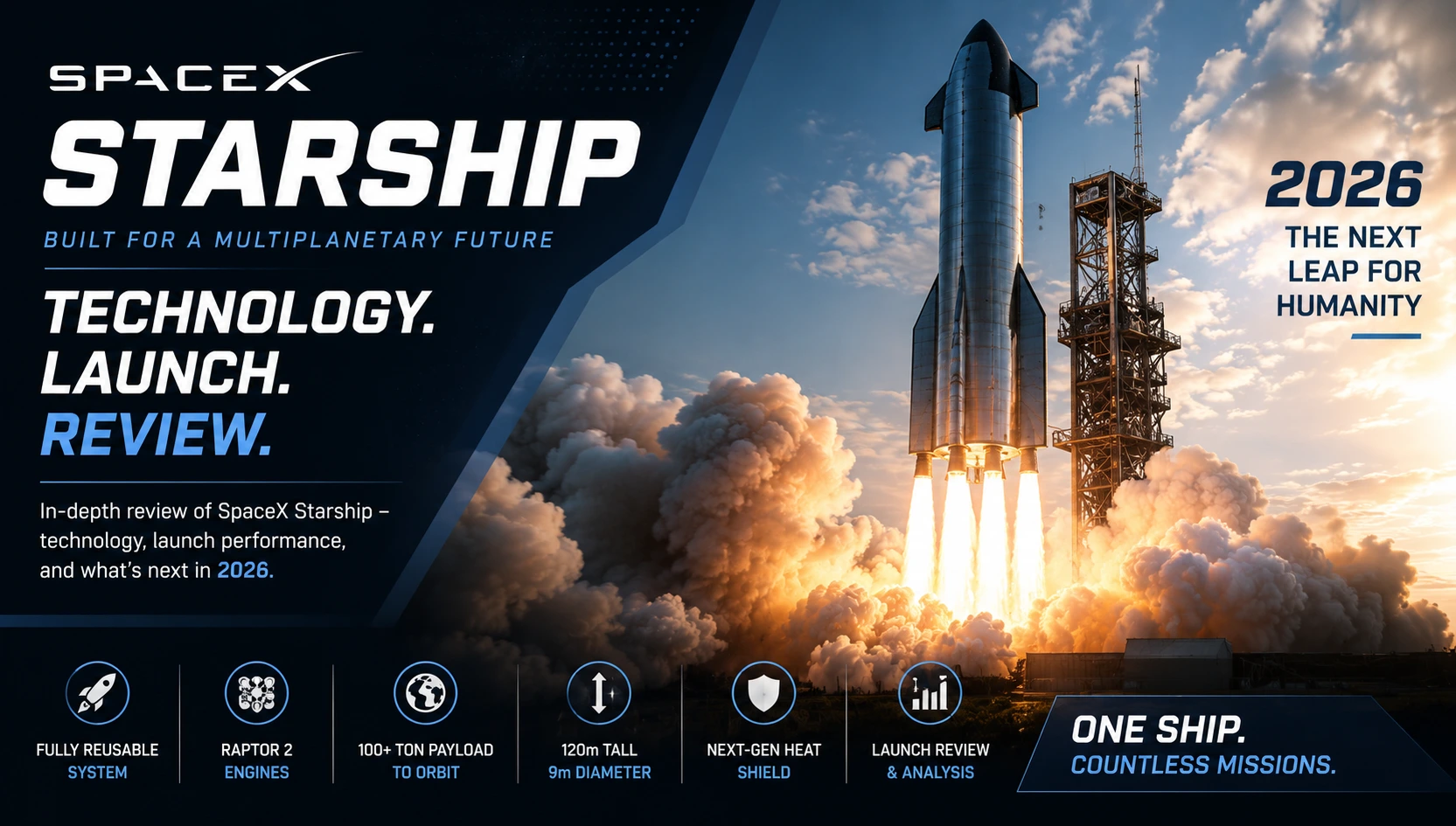
SpaceX's Starship is the most ambitious engineering project in human spaceflight history. At 123 metres tall and capable of generating over 7,500 tonnes of thrust at liftoff, the fully integrated Starship and Super Heavy booster surpasses every rocket ever launched — including the Saturn V that carried Apollo astronauts to the Moon. But raw scale is only the beginning of what makes Starship technically extraordinary. It is designed to be fully and rapidly reusable, with both the 71-metre Super Heavy booster and the 50-metre Starship upper stage returning to the launch site for propulsive landings, enabling a launch cadence and cost structure that could transform access to space.
Full Technical Specification
- Total Height: 123 metres (Super Heavy booster + Starship)
- Total Mass at Liftoff: Approximately 5,000 tonnes (fully fuelled)
- Payload to Low Earth Orbit (LEO): Over 150 tonnes (expendable), 100+ tonnes (reusable)
- Payload to Geostationary Transfer Orbit: 21 tonnes (with full reuse)
- Super Heavy Booster Engines: 33 Raptor 2 engines — 3 fixed centre ring, 10 inner ring (fixed), 20 outer ring (gimballing)
- Super Heavy Thrust: Approximately 7,590 tonnes-force at sea level (full throttle)
- Starship Upper Stage Engines: 6 Raptor engines — 3 sea-level optimised, 3 vacuum-optimised
- Starship Thrust (sea level): Approximately 1,500 tonnes-force
- Propellant: Liquid methane (CH₄) + liquid oxygen (LOX) — Methalox
- Propellant Mass: ~3,400 tonnes (Super Heavy) + ~1,200 tonnes (Starship)
- Booster Landing: Mechazilla tower catch — chopstick arms capture the booster mid-air
- Starship Landing: Propulsive belly-flop to vertical landing (ocean platform or land)
- Heat Shield: ~18,000 hexagonal Transpiring Thermal Protection System (TTPS) tiles
- Crew Capacity: Up to 100 passengers (crew transport variant)
- Intended Destinations: Earth orbit, Moon (NASA Artemis HLS), Mars
Raptor Engine Technology
The SpaceX Raptor engine is the most technically advanced rocket engine in operational history. It uses a full-flow staged combustion cycle — the only engine in production to do so — in which both the fuel-rich and oxidiser-rich preburner exhaust gases are fully combusted in the main chamber rather than being dumped overboard. This eliminates the single largest source of efficiency loss in conventional rocket engines and allows Raptor to achieve a chamber pressure of over 300 bar — approximately three times that of the Space Shuttle Main Engine.
The result is a specific impulse (Isp) of approximately 363 seconds at sea level and 380 seconds in vacuum — making Raptor the most efficient sea-level rocket engine ever built. Each Raptor produces approximately 230 tonnes of thrust, and the 33 engines on Super Heavy collectively produce a liftoff thrust-to-weight ratio that allows the fully loaded vehicle to leave the pad with thrust to spare, enabling throttle-down for gravity turn manoeuvres and engine-out redundancy throughout the ascent phase.
Mechazilla — The Booster Catch System
One of the most audacious engineering decisions in the Starship programme is the Mechazilla tower catch system for Super Heavy booster recovery. Rather than landing the 70-metre, 230-tonne booster on landing legs, SpaceX designed the launch tower at Starbase to catch the returning booster using two large mechanical arms — nicknamed "chopsticks" — that hydraulically close around the booster's grid fin attachment points as it descends vertically at low speed.
The system eliminates the weight and complexity of landing legs (which would add several tonnes to the booster), allows the booster to be immediately re-stacked onto a new Starship upper stage without requiring a crane to lift it from a landing pad, and enables turnaround times that SpaceX believes could ultimately reach less than one hour between flights. The precision required — catching a 230-tonne rocket descending at approximately 1 m/s to within centimetres of the target position — is achieved through a combination of GPS, radar altimetry, and the booster's own flight computer making continuous thrust vector adjustments during the final metres of descent.
Heat Shield and Reentry Technology
Starship reenters the Earth's atmosphere base-first in a controlled belly-flop orientation, using its large flat undersurface and the 18,000 hexagonal heat shield tiles to distribute the aerodynamic heating load across the maximum possible surface area. The Transpiring Thermal Protection System (TTPS) tiles are made from a silica-based ceramic material that can withstand temperatures exceeding 1,400°C — the peak heating environment during reentry from orbital velocities.
The reentry sequence ends with a dramatic "flip manoeuvre" — the Starship reignites its Raptor engines in the final kilometres of descent to transition from the horizontal belly-flop attitude to vertical, then performs a supersonic retropropulsion landing burn to touch down on the designated platform. The entire sequence, from peak heating at approximately 70 km altitude to touchdown, takes approximately eight minutes.
The Path to Mars
Starship's design is explicitly optimised for the Mars mission profile. The methane/oxygen propellant combination was chosen because both can be produced on Mars through the Sabatier process — combining atmospheric CO₂ with water ice to produce methane and oxygen — enabling in-situ propellant production for the return journey. The 100-person crew transport variant includes life support systems for the six-to-nine month transit to Mars, sleeping quarters, recreational areas, and radiation shielding.
In 2026, Starship has now completed multiple successful orbital test flights, demonstrated full booster catch, and been selected by NASA as the Human Landing System for the Artemis programme's crewed Moon landings. The first uncrewed Mars mission is planned for the late 2020s, with the first crewed Mars landing targeted for the early 2030s — a timeline that, by any historical measure of space programme progress, represents the fastest path humanity has ever charted to another planet.
Verdict
SpaceX Starship is not merely the world's largest and most powerful rocket — it is a genuine paradigm shift in what is possible in space exploration. Full reusability, methane propellant producible on Mars, a 100-person crew capacity, and a launch cost structure targeting under $10 million per flight collectively represent a discontinuity in the economics of space access that no previous rocket has achieved. Whether Starship ultimately delivers on its most ambitious goals — a self-sustaining human civilisation on Mars — remains to be seen. What is already certain is that it has permanently changed what the aerospace industry believes a rocket can be.