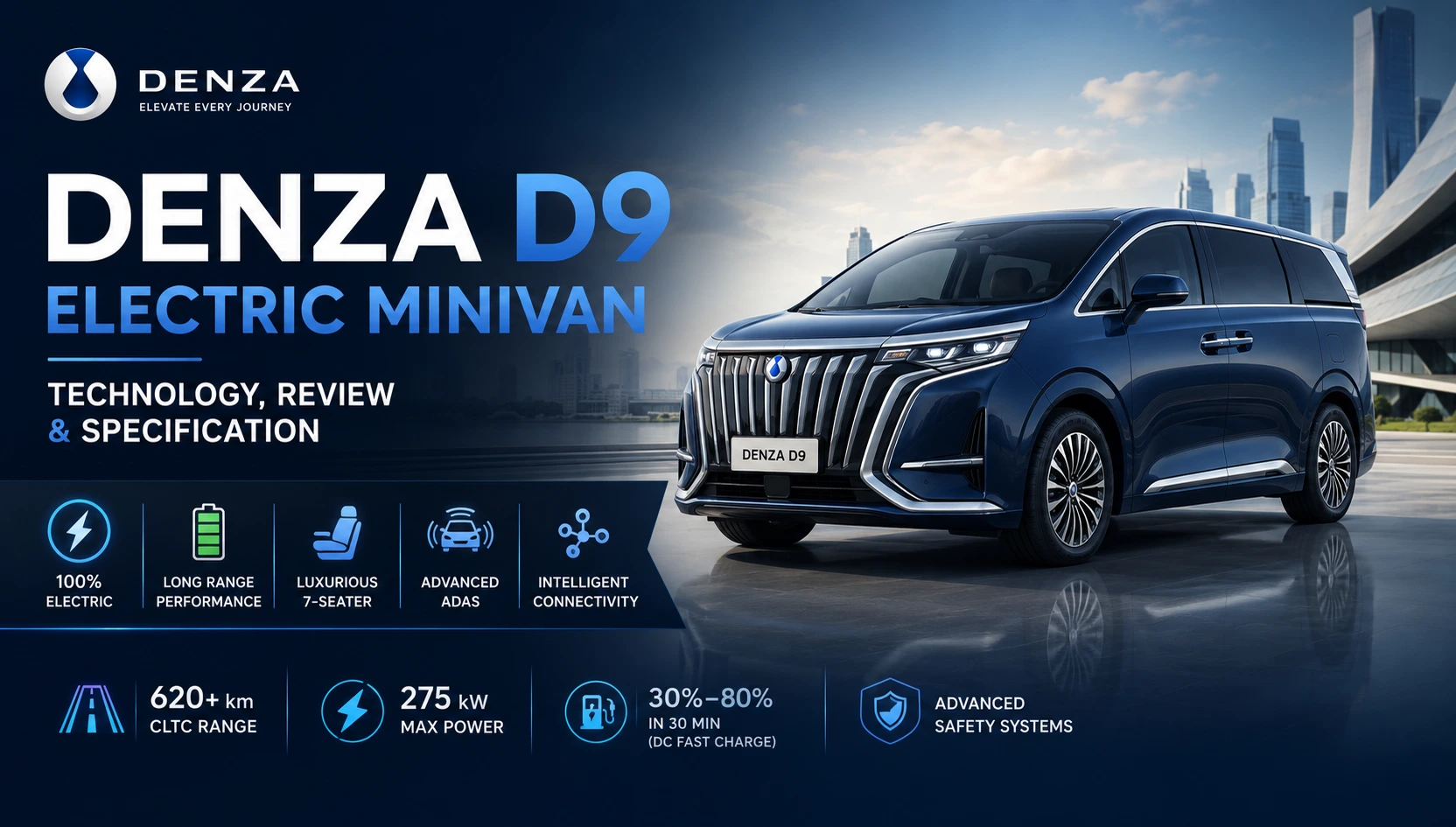
The Denza D9 represents the luxury electric MPV segment at its most ambitious. Born from the joint venture between BYD — the world's largest electric vehicle manufacturer by volume — and Mercedes-Benz, Denza occupies the premium tier of BYD's brand portfolio. The D9 is its flagship people carrier, a seven or eight-seat electric MPV that targets the segment dominated by the Toyota Alphard and takes the fight directly to premium family transportation with a combination of cutting-edge BYD battery technology and Mercedes-influenced luxury interior design.
Full Specification
- Powertrain (EV): Dual electric motors — front and rear — producing a combined 360 kW (483 hp) and 600 Nm torque
- Powertrain (PHEV): 1.5T turbocharged petrol engine + front electric motor; combined system output 272 kW
- Battery (EV): 103.36 kWh BYD Blade Battery (LFP chemistry)
- Range (EV): 620 km CLTC (approximately 520 km WLTP equivalent)
- 0–100 km/h: 4.9 seconds (EV AWD)
- Top Speed: 200 km/h
- DC Fast Charging: 166 kW peak; 30–80% in approximately 25 minutes
- AC Charging: 11 kW on-board charger
- Body: Full-size MPV, 5,250 mm length, 1,960 mm width, 1,920 mm height
- Wheelbase: 3,110 mm
- Seating: 6, 7, or 8-seat configurations
- Suspension: Front MacPherson strut / rear multi-link with CDC (Continuous Damping Control)
- Air Suspension: Optional — adjustable ride height across three settings
- Infotainment: 15.6-inch central touchscreen + 12.8-inch co-pilot screen, DiLink 4.0 OS
- ADAS: DiPilot intelligent driving suite — L2+ highway assist, AEB, LCC, ACC with Stop & Go
BYD Blade Battery Technology
The Denza D9's most technically significant feature is its BYD Blade Battery — a lithium iron phosphate (LFP) cell format that BYD developed to address the thermal safety limitations of conventional lithium-ion pouch and prismatic cells. The Blade Battery uses an elongated, flat cell geometry that stacks directly into the battery pack without conventional module housings, reducing wasted space and increasing volumetric energy density by approximately 50% over traditional LFP pack designs.
The key safety advantage is thermal stability: Blade Battery cells do not reach thermal runaway under nail penetration tests — the most severe safety scenario — where conventional NMC (nickel manganese cobalt) battery cells typically generate temperatures exceeding 500°C. In the D9's 103 kWh pack, this translates to a battery system that is both longer-lived and more thermally resilient than rivals using NMC chemistry, while the LFP chemistry also supports a longer cycle life — approximately 3,000 full cycles to 80% capacity versus roughly 1,500 for NMC.
Interior and Cabin Technology
The D9's interior is the most direct expression of the Mercedes-Benz influence on the Denza brand. The second-row captain's chairs feature powered reclining backrests, ventilation, heating, and an ottoman footrest function — a feature set previously reserved for executive saloons rather than family MPVs. The ambient lighting system offers 64 colour options across 30+ individual lighting zones, and the panoramic sunroof spans virtually the full ceiling area for all three seating rows.
The DiLink 4.0 infotainment system runs a customised version of Android Automotive, providing native access to Chinese app stores and cloud services as well as Apple CarPlay integration for international markets. The system is notable for its voice recognition capability — a continuous-listening natural language interface that can respond to commands from any seat in the cabin without requiring a wake word.
DiPilot Driver Assistance Suite
BYD's DiPilot L2+ system on the D9 provides a comprehensive highway driving assistance package built around a forward-facing camera cluster, front and corner radar modules, and twelve ultrasonic sensors. The system handles lane centring, adaptive cruise control with stop-and-go capability in traffic, automatic lane changes on highways when the turn signal is activated, and a traffic jam pilot mode for low-speed queuing that requires only minimal driver supervision.
Verdict
The Denza D9 makes a compelling argument that the future of premium family transportation is electric, Chinese-developed, and more technologically sophisticated than anything the established Japanese or European MPV manufacturers currently offer at comparable price points. Its Blade Battery technology is genuinely class-leading in safety and longevity, its interior ambition matches anything from the European luxury tier, and the EV range of 620 km CLTC removes the range anxiety concern entirely for the school run and weekend trip segments this car targets. The D9 is a landmark vehicle that signals BYD's arrival as a genuine global luxury contender.